CHAPTER 6
FIRE PROTECTION REQUIREMENTS
601.1 Scope. The provisions of this chapter establish general requirements for new and existing buildings, structures and premises located within wildland-urban interface areas.
601.2 Objective. The objective of this chapter is to establish minimum requirements to mitigate the risk to life and property from wildland fire exposures, exposures from adjacent structures and to mitigate structure fires from spreading to wildland fuels.
603.1 Objective. Provisions of this section are intended to modify the fuel load in areas adjacent to structures to create a defensible space.
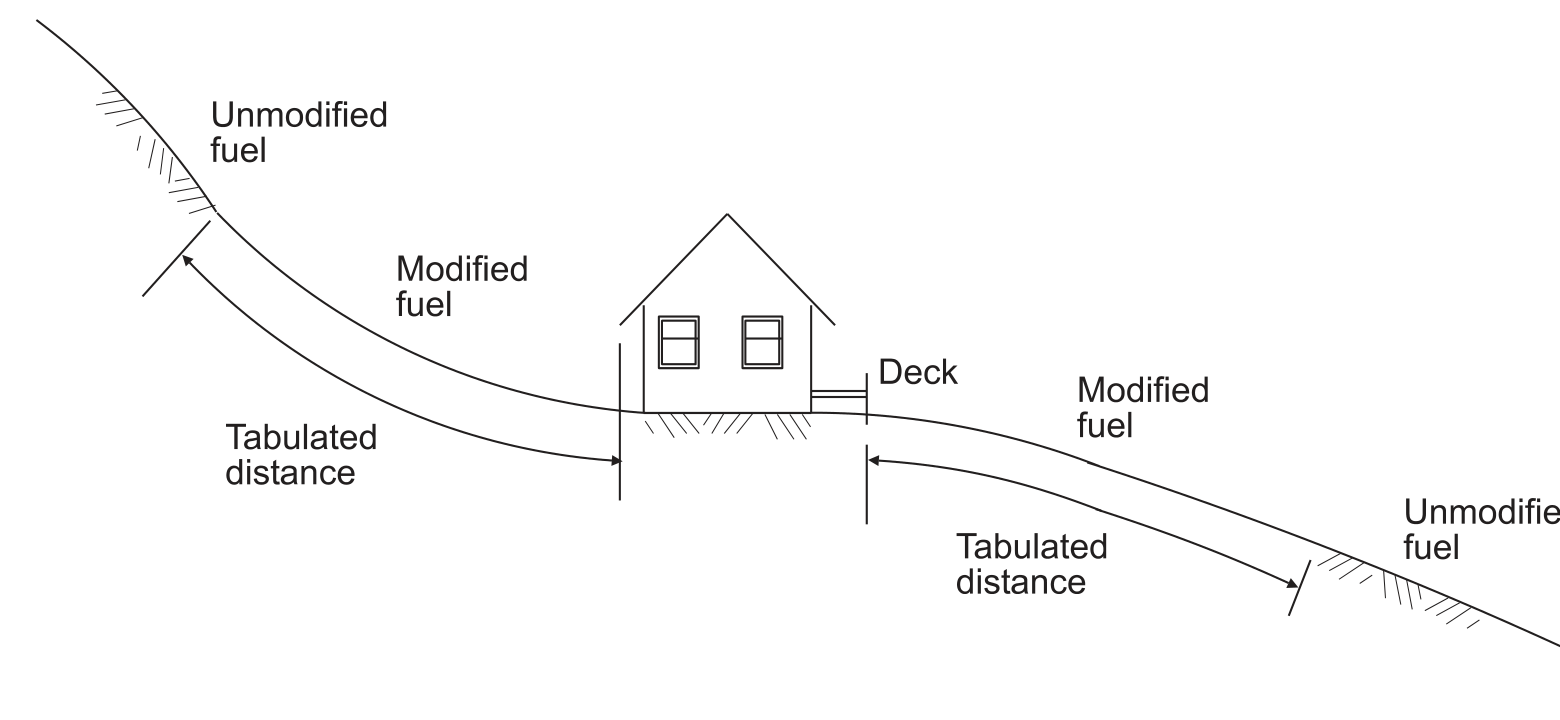
603.2 Fuel modification. In order to qualify as a conforming defensible space for individual buildings or structures on a property, fuel modification shall be provided within a distance from buildings or structures as specified in Table 603.2. For all other purposes, the fuel modification distance shall not be less than 30 feet (9144 mm) or to the property line, whichever is less. Distances specified in Table 603.2 shall be measured on a horizontal plane from the perimeter or projection of the building or structure as shown in Figure 603.2. Distances specified in Table 603.2 may be modified by the code official because of a site-specific analysis based on local conditions and the fire protection plan.
Persons owning, leasing, controlling, operating or maintaining buildings or structures requiring defensible spaces are responsible for modifying or removing nonfire-resistive vegetation on the property owned, leased or controlled by said person.
Trees are allowed within the defensible space, provided the horizontal distance between crowns of adjacent trees and overhead electrical facilities or unmodified fuel is not less than 10 feet (3048 mm). Deadwood and litter shall be regularly removed from trees.
Where ornamental vegetative fuels or cultivated ground cover, such as green grass, ivy, succulents or similar plants are used as ground cover, they are allowed to be within the designated defensible space, provided they do not form a means of transmitting fire from the native growth to any structure.
| WILDLAND-URBAN INTERFACE AREA |
FUEL MODIFICATION DISTANCE (feet) |
|---|---|
| Moderate hazard | 30 |
| High hazard | 50 |
| Extreme hazard | 100 |
603.3 Community fuel modification zones. Fuel modification zones to protect new communities shall be provided when required by the code official in accordance with Section 603, in order to reduce fuel loads adjacent to communities and structures.