Self-Improving Pretraining:
using post-trained models to pretrain better models
FAIR at Meta
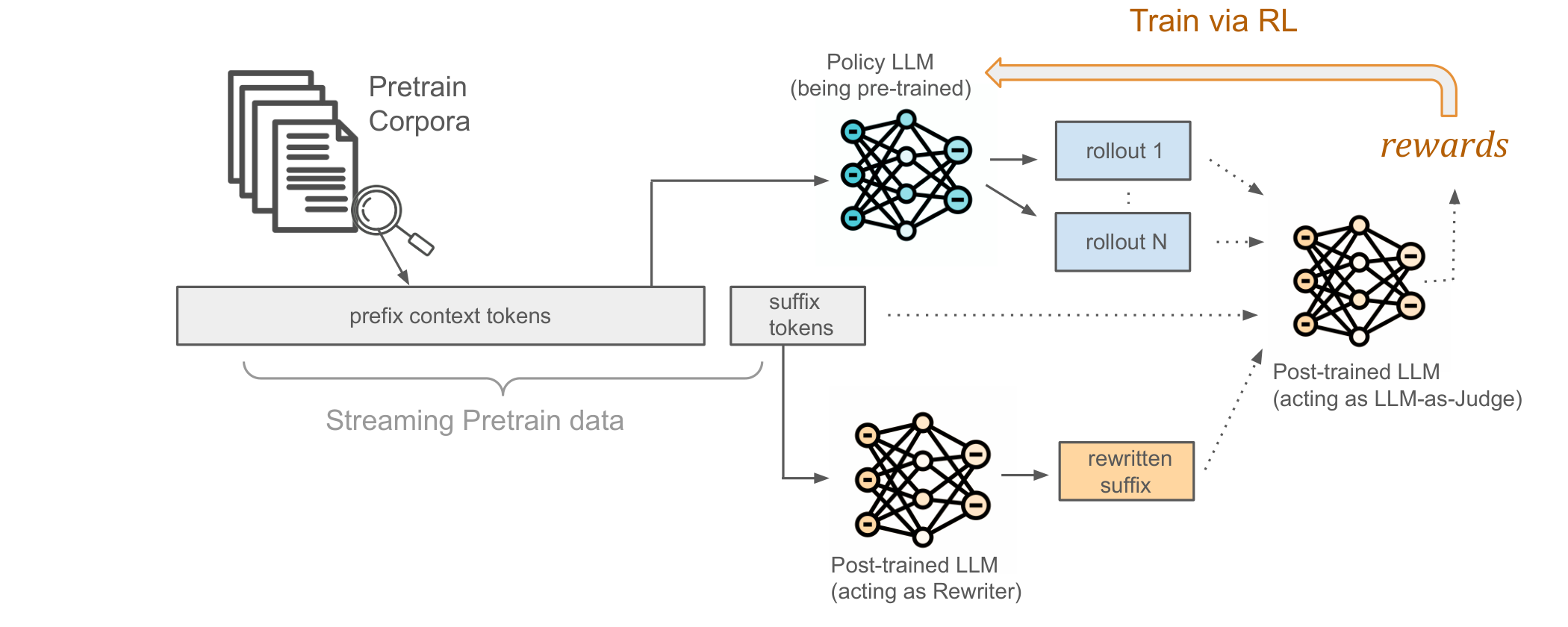
Ensuring safety, factuality and overall quality in the generations of large language models is a critical challenge, especially as these models are increasingly deployed in real-world applications. The prevailing approach to addressing these issues involves collecting expensive, carefully curated datasets and applying multiple stages of fine-tuning and alignment. However, even this complex pipeline cannot guarantee the correction of patterns learned during pretraining. Therefore, addressing these issues during pretraining is crucial, as it shapes a model’s core behaviors and prevents unsafe or hallucinated outputs from becoming deeply embedded. To tackle this issue, we introduce a new pretraining method that streams documents and uses reinforcement learning (RL) to improve the next K generated tokens at each step. A strong, post-trained model judges candidate generations—including model rollouts, the original suffix, and a rewritten suffix—for quality, safety, and factuality. Early in training, the process relies on the original and rewritten suffixes; as the model improves, RL rewards high-quality rollouts. This approach builds higher quality, safer, and more factual models from the ground up. In experiments, our method gives 36.2% and 18.5% relative improvements over standard pretraining in terms of factuality and safety, and up to 86.3% win rate improvements in overall generation quality.
Correspondence: olggol@meta.com, ellenxtan@meta.com