Be aware:
Make sure your gate system is installed and maintained according to the manufacturer's instructions. Make sure your installer adheres to UL 325 and ASTM F2200 standards discussed in this brochure and in the Important Safety Instructions found in the operator's manual.
Do:
Review the illustrations found in this brochure for more information and safety requirements.
Operate your gate system only when all necessary entrapment protection devices are connected and working properly. Examples of these devices include:
- Edge sensors
- Photoelectric sensors (e.g. photo eyes)
- Proper adjustment of the inherent sensing system
Follow ASTM F2200 standard for automated gates. Where applicable, these include the following:
All gate types:
- No protrusions along the bottom of the gate.
- Fall-over protection to prevent the gate from falling when gate is detached from supporting hardware.
Slide gates:
- Covers for all exposed weight bearing rollers and pinch points that exist less than 8 feet (2.5 m) above grade.
- Physical gate stops to avoid over-travel in both directions.
- Protective screen mesh to guard openings from the gate's base support to a minimum height of 6 feet (1.8 m) above the ground. This must prevent a sphere of 2-1/4 inches (57 mm) from passing through any opening in the gate or adjacent fence (the portion covered in the gate's open position.) Refer to the illustrations.
- A gap (measured horizontally, parallel to the roadway) between a fixed stationary object nearest the roadway and the gate frame shall not exceed 2-1/4 inches (57 mm) when opened or closed.
Precautions for gate systems:
Entrapment zone hazards:
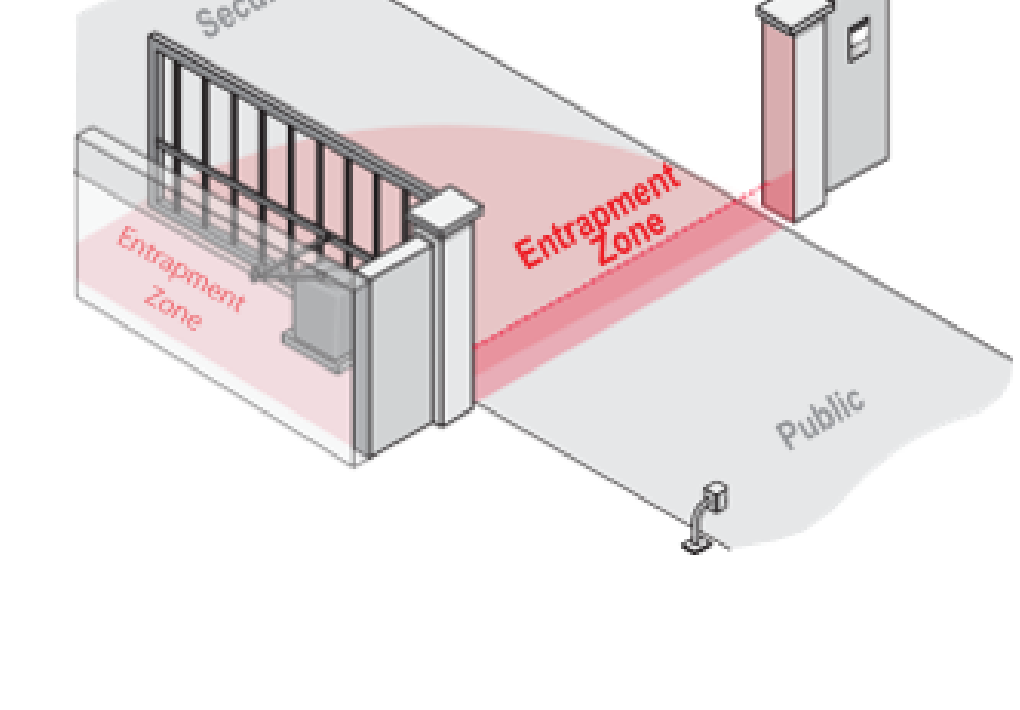
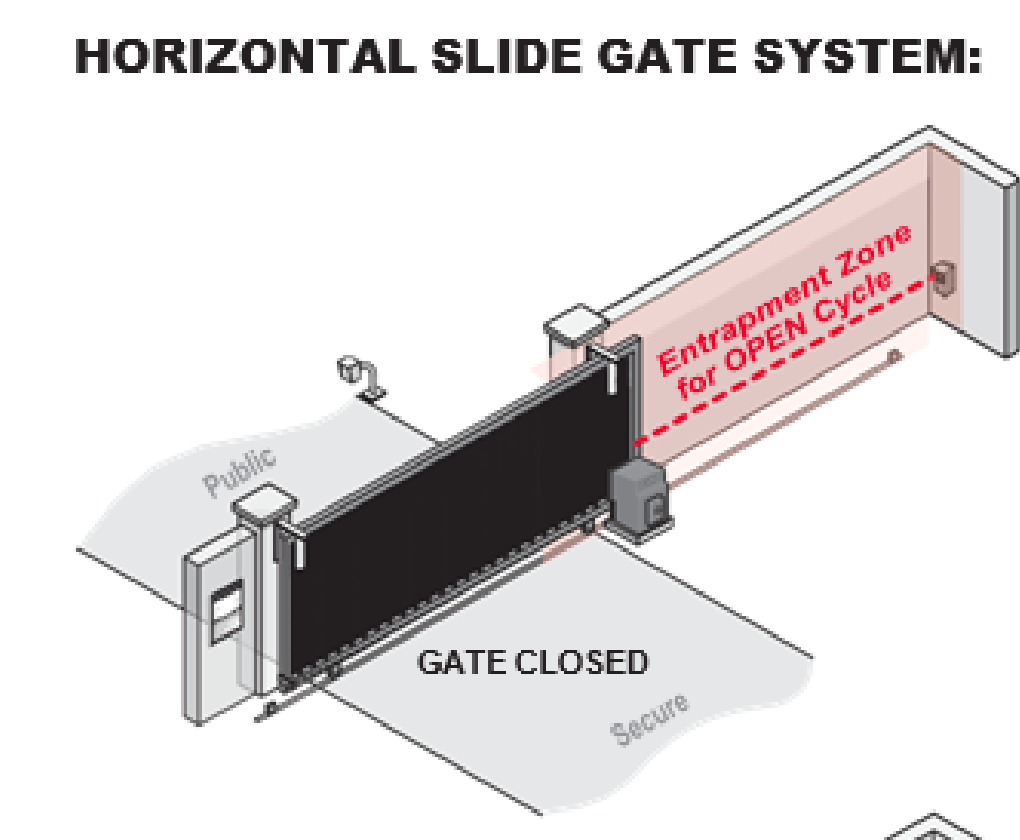
Body parts may become entrapped between a gate and a stationary object when the gate moves, which can result in serious injury or death. Make sure pedestrians stay clear of the gate path and areas where gate motion is close to stationary objects.
Pinch point hazards:
- In open roller slide gates, severe injury can occur when hands and fingers get caught in the slide gate rollers. Feet can be injured between the bottom of the gate and bottom rollers. Make sure roller guards are installed to cover these pinch points.
- A swing gate's opening mechanism may have arms that can overlap with a scissoring effect, which can result in serious injury. Make sure pedestrians stay clear of the gate path and the opening mechanism, especially when the gate is in motion.
Crush hazards:
In picket gates, body parts positioned between the bars, when the gate begins to move, can result in serious injury or death. Make sure openings are covered or screened and gaps are filled to prevent persons from reaching through, and/or passing through, the gate.
Safety checklist:
- Automated gates are for vehicular use only; provide and maintain walkways and signs to direct pedestrians to a separate walk-through entrance.
- Clearly display warning signs on both sides of the gate in clear view.
- Never let children operate or play with gate controls.
- Keep all remote controls, especially radio transmitters, away from children. Do not allow children to play on or around the gate or gate operator.
- Make sure all access control devices are mounted at least 6 feet (1.8 m) away from any moving part. Create a safe design where a person need not reach over, under, through or around the gate to operate the access controls.
Horizontal slide gate system:
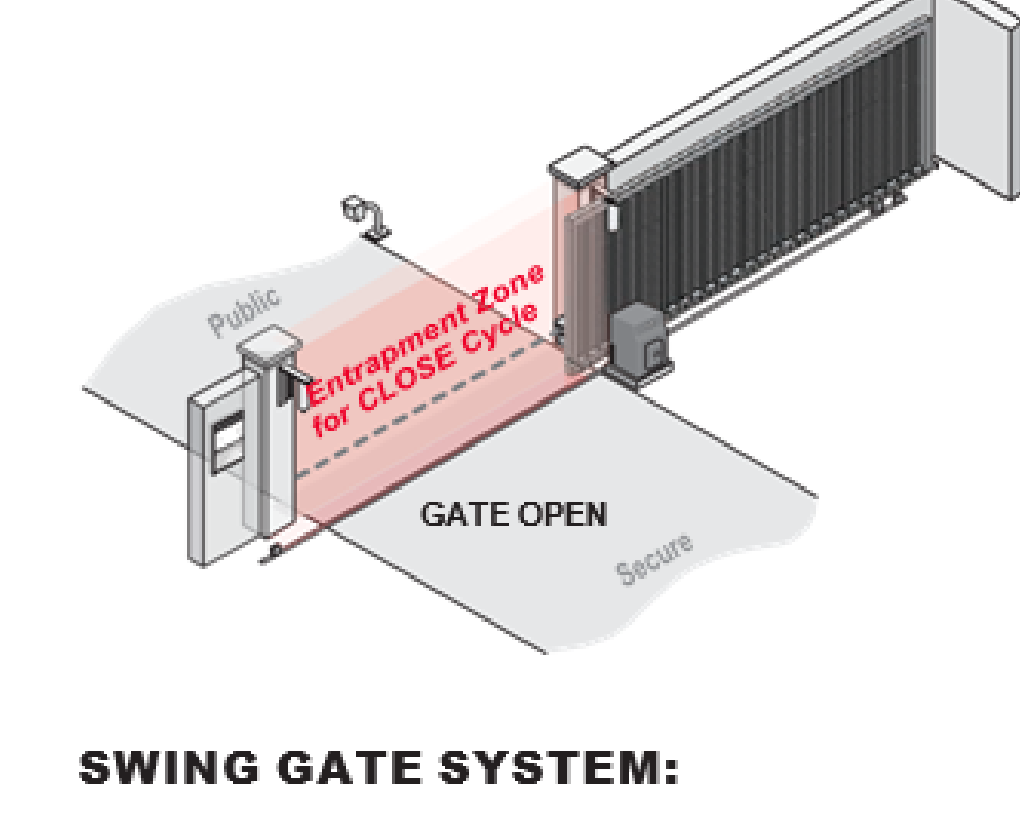
Swing gate system: