When we sorted the data by the way people were stopped in Oakwood in 2016, a similar pattern was evident.
In Oakwood, Black drivers accounted for 21.9% of the stops where a problem with driving or equipment was observed (Figure 7), but they accounted for 36.8% of the stops where a license plate check was run without tickets being written for an observable driving or equipment problem. (Figure 8.)
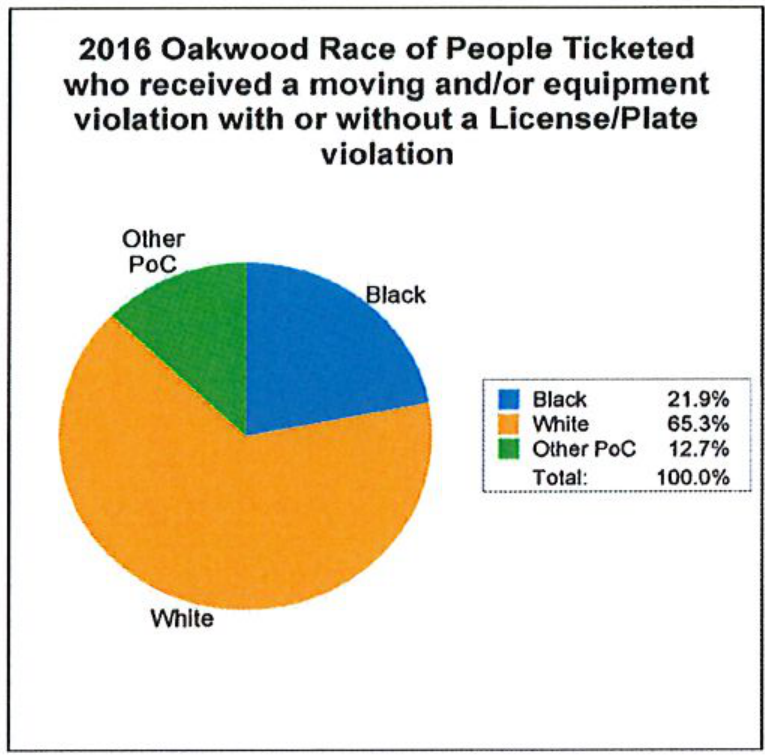
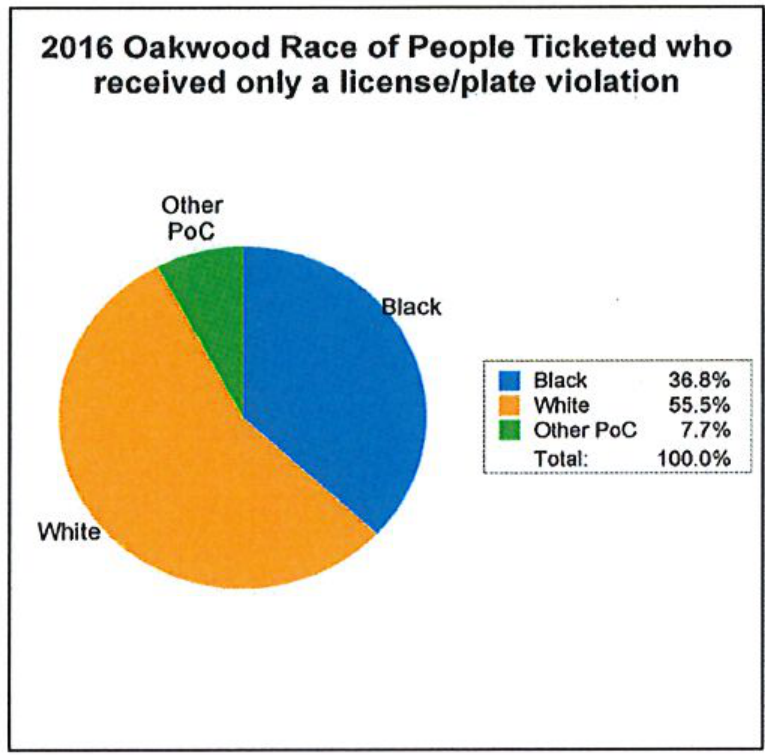
These “license plate check” stops do not result from bad driving or faulty equipment but from an officer’s decision to run the plate of a passing car. In these stops, officer discretion is at its greatest. It is striking that such an outsized percentage of these tickets are given to Black drivers.
We did not have all of the data we would have needed to fully explore the causes and consequences of the racial divide in police stops in Oakwood.
For example:
Some police stops may be unrecorded.
We had only one year of data. To assess the full scope of the problem, analysis of trends across multiple years would be preferred.
Because time of day of the stop was not provided, we could not tell whether the ability of the officers to see the race of drivers had an impact on the frequency of stops. Time of day can be an important variable in determining the existence of racial profiling.
Racial disparities across police stops may be most strongly associated with certain officers. We did not attempt to do this analysis.