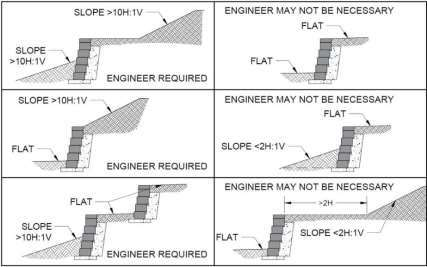
Is There a "Surcharge" on my wall?
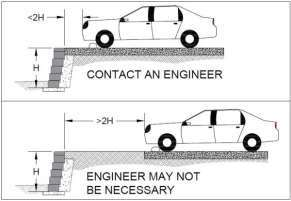
A surcharge is any slope, structure or object that could impose a lateral force on the wall. Any surcharge on the wall will require evaluation by an engineer. This includes vehicles, swimming pool, equipment (such as an air handler or pool pump), footings from a structure (such as your house or porch), or simply a fence on top of the wall. A fence imposes wind load on the wall, even if it is not attached to the wall itself. Trees will also create a surcharge behind the wall as they grow and increase in weight, the roots will push the face of the wall out, and the height of the tree will impose wind loads on the wall. Small shrubs and plants are acceptable behind the wall.
As a general rule, the edge of any surcharge object must be at least 2 times the total wall height away from the back of the retaining wall. This means if you have a total wall height of 4-ft (buried height plus exposed height), the edge of any surcharge should be at least 8-ft away from the back of your wall.
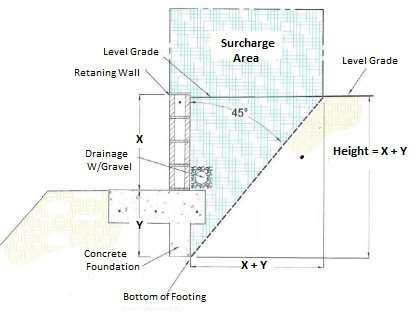
Surcharge Area =
Wall Height(X) + Footing Depth (Y)