The improved beginning year balances from 2016 to 2018 are a result of: 1) cost cutting; 2) changing the refuse services to a self-funded operation; 3) paying for storm sewer operations through a stormwater utility with monthly fees; 4) approval of a 3.75 mill property tax in 2013; and 5) some increases in income tax collections. The slight drop in 2019 is the result of the decrease in income taxes caused by other communities raising their tax rates. The increase in 2020 is primarily the result of the 10% credit reduction for local taxes paid to other jurisdictions.
The increase in 2021 is the result of an increase in income tax revenue as well as a significant rebate of past premiums paid to the Bureau of Workers’ Compensation and receipt of CARES Act monies to offset the impact of the COVID-19 pandemic. Additionally, several capital projects were postponed as a result of the COVID-19 pandemic. The increase in both 2022 and 2023 is primarily the result of an increase in income tax revenue. Income tax revenues increased as a result of additional residents living in the homes and condominiums at Pointe Oakwood; an increase in the number of Oakwood residents working from home, thereby directing their local income taxes to Oakwood rather than other jurisdictions; and despite difficult economic conditions brought on by the pandemic, the total earned income in Oakwood has increased. Additionally, the city received $468,000 of monies from the Federal American Rescue Plan Act in 2022 and $471,765 in 2023.
The decrease in 2024 is due to increased capital expenditures in 2023, specifically the Far Hills Stormwater Reconstruction project, which used the $939,765 received from the Federal American Rescue Plan Act in 2022 and 2023. The increase in 2025 is due to an increase in income tax collections and investment income.
How do our water and sanitary sewer rates compare to those in other Miami Valley communities?
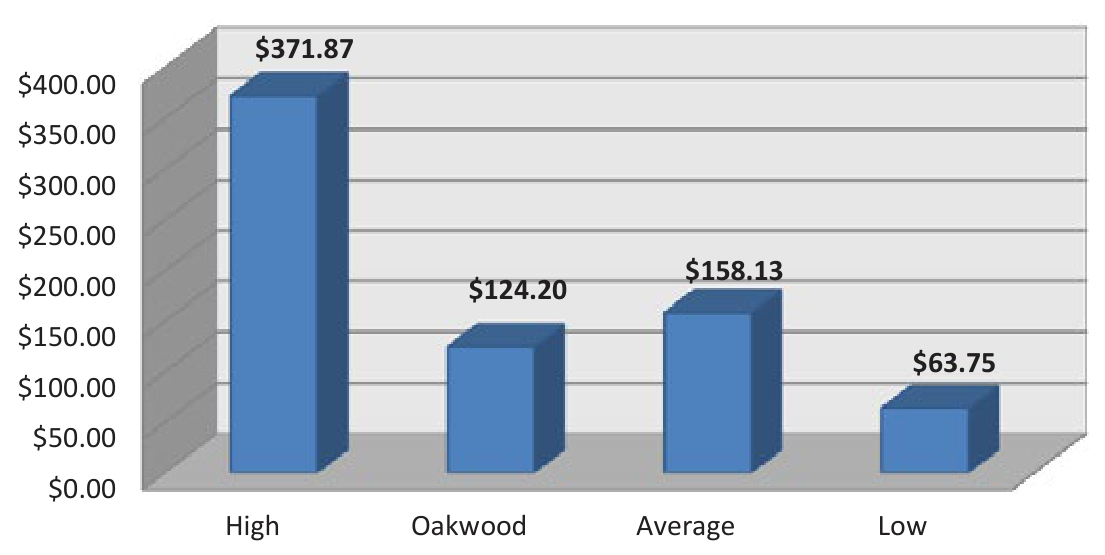
Based on the 2024 rate survey, our water rates are the 16th lowest out of 69 jurisdictions. Our target beginning-year water fund balance is $1.0 million. We started 2025 at $869,643 and raised water rates in 2025.
Annual Water Rate Survey
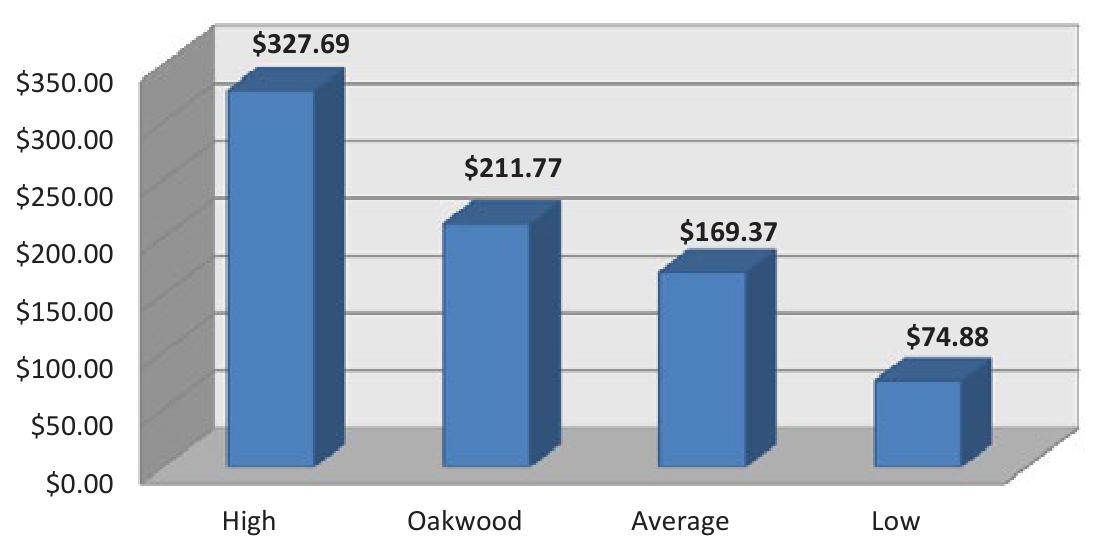
Our sanitary sewer rates rank 56th lowest out of 66 jurisdictions. Unlike our water system, which is 100% run by Oakwood, about 65% of our sanitary sewer operation costs (i.e., the wastewater treatment) were contracted. We use Montgomery County and the city of Dayton wastewater treatment plants and must pay County and Dayton rates. We raised our sanitary sewer rates effective January 1, 2024. Over the last few years, Montgomery County and Dayton raised their rates several times, which is what necessitated this Oakwood increase. We started 2025 with a $1,343,943 balance.
Annual Sanitary Sewer Rate Survey
Does Oakwood offer a paperless way to pay the monthly water/sanitary sewer/stormwater/refuse bill?
Yes, and there is no charge to participate in either the E-Statement or autopay programs. As the city continues to look for ways to cut costs, we encourage residents to utilize paperless options for both receiving and paying the monthly utility bill. Residents can register via the city website at www.oakwoodohio.gov to have their monthly utility bill emailed directly to them. The process is quick and easy; just click on the “Online E-Statement” link under the Water/Sewer/Stormwater/Refuse Department tab. To register, you will need your Oakwood water/sewer/stormwater/refuse account number (printed on your monthly statement) and a valid email address.
Direct and automatic payment of your monthly utility bill through an ACH (Automatic Clearing House) is also a simple process. Complete a “Utility Bill Authorization Form” (available at the City Building or on the city website under the Water/Sewer/Stormwater/Refuse Department tab). The completed form will authorize the city to process a withdrawal from your bank account in the amount of our current net bill on the net due date each month. You will still receive an invoice either by email (E-Statement) or regular mail if so desired.
Does Oakwood invest the money it holds in the fund balances?
Yes, most of it. We keep most dollars not immediately required for cash flow safely invested. All investments are guided by an investment advisor and are overseen by the City Manager and Finance Director. Our investment protocol is governed by city ordinances, which encompass a philosophy of protecting the principal first and maximizing return second.
Does Oakwood accept credit cards as payment for various non-OCC-related fees and services (e.g., water bills, sewer bills, refuse bills, taxes, etc.)? How does this work?
The City of Oakwood partners with Invoice Cloud to offer an easy-to-use payment portal for our citizens to make credit card, debit card, or electronic check payments. A convenience fee will be added by Invoice Cloud for providing this service. The user fee is required in lieu of the city using general tax dollars to provide this service. The Oakwood Community Center continues to accept traditional credit card payments as it has in the past, with no convenience fee. OCC payments may be made through the Community Center’s online payment portal.
Do we have short-term or long-term debt?
No. Remarkably, the city does not carry any short-term or long-term debt. For decades, Oakwood city leaders have prudently managed our city and our city finances. As a result, our annual budget is void of any debt service obligations.