Does the city have a process for keeping the grass and/or weeds cut on vacant properties where the property owner fails to do so?

Yes. The city has an ordinance in place that defines weeds or grass taller than eight (8) inches in height as a public nuisance; the ordinance also includes other vegetation that is not managed or maintained. If violations exist, the city is required to place a placard on the front door or in the yard and provide the owner a minimum of five (5) days to correct the violation. If the weeds, grass, and/or vegetation are not cut, city crews perform the work after normal work hours, and the property owner is billed for the work. If the bill is not paid, the cost is certified to the county for placement on the property tax bill.
Why can’t I put my yard debris in the street, other than leaves in the fall? Why does it have to be behind the curb?
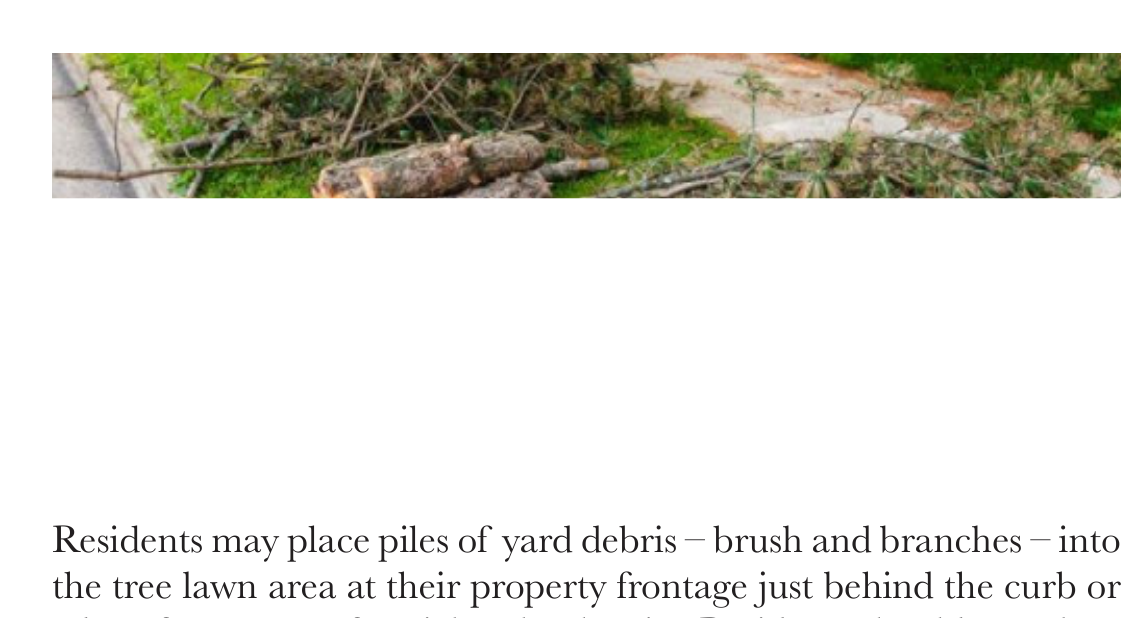
Residents may place piles of yard debris – brush and branches – into the tree lawn area at their property frontage just behind the curb or edge of pavement for pickup by the city. Residents should not place yard debris in front of other properties, nor should they place yard debris in any roadway center medians. Any amount of debris in the street is an obstruction and disrupts the stormwater collection system by diverting water away from the intended storm drains. Debris in the street can be dangerous to vehicles and is hard to see at night. Debris in the street also interferes with on-street parking and is a danger to pedestrians, joggers, and bicyclists.
It is against the law to place yard debris in the street. The only exception is for leaves during the published fall collection program. The City’s code enforcement officer responds to yard debris piles placed in the gutter or street by leaving a door-hanger notice at the property affording two business days to remove the obstruction from the street. After two days, the city will remove the obstruction and will charge the property owner $150.
Property owners who routinely use the city’s monthly collection program and wish to construct a hard surface pad (e.g., concrete, brick, paver) for debris placement should contact the code enforcement officer at (937) 297-2920 or see the city website for permitting information.
In addition to the monthly pick-up, the city offers other options for disposing of yard debris, such as the 24/7/365 Recycling and Yard Waste Drop-Off Facility located at the Foell Public Works Center. Also, residents are provided two free special pickups per year, which can be used for yard debris. Additionally, dumpsters are available to be delivered free of charge for large amounts of green waste. More information on these options is available by contacting the Public Works Center at (937) 298-0777.
If I am considering a larger construction project such as a room addition, construction of a deck, or a new garage, what type of information does the city require to be submitted before a permit can be issued?
Besides detailed plans, a certified plot plan is required to determine if the proposed improvements meet the zoning setback requirements. If the proposed improvement meets all zoning requirements, the plans are released to the city of Kettering for issuance of the required permit(s). If a zoning variance is needed, the five (5) member Board of Zoning Appeals meets once a month (as needed) to act on variance requests. If the amount of impervious surface you are adding exceeds 625 square feet on a lot of less than 40,000 square feet, or 1,000 square feet for a lot that exceeds 40,000 square feet, a drainage study by a licensed engineer is also required. If your improvement project is time-sensitive, we strongly recommend that you plan ahead well in advance of when you hope to have the project completed. Our zoning staff will be happy to assist you with the application process.
What are the 2024 statistics for the types of Oakwood permits?
| TYPE OF PERMIT | NUMBER OF PERMITS |
ESTIMATED VALUE OF PERMITTED PROJECTS |
|---|---|---|
| Hard Surface Work on Private Property (Driveways, Patios, Walkways) |
56 | $858,312 |
| A/C Units/Heat Pumps | 67 | $725,407 |
| Fences/Retaining Walls | 81 | $428,980 |
| Accessory Structures (Garages, Storage Sheds, Decks, etc.) |
25 | $237,183 |
| New Home Construction | 1 | $1,500,000 |
| All Other | 20 | $1,138,152 |
| Total | 250 | $4,888,035 |
Accessible view
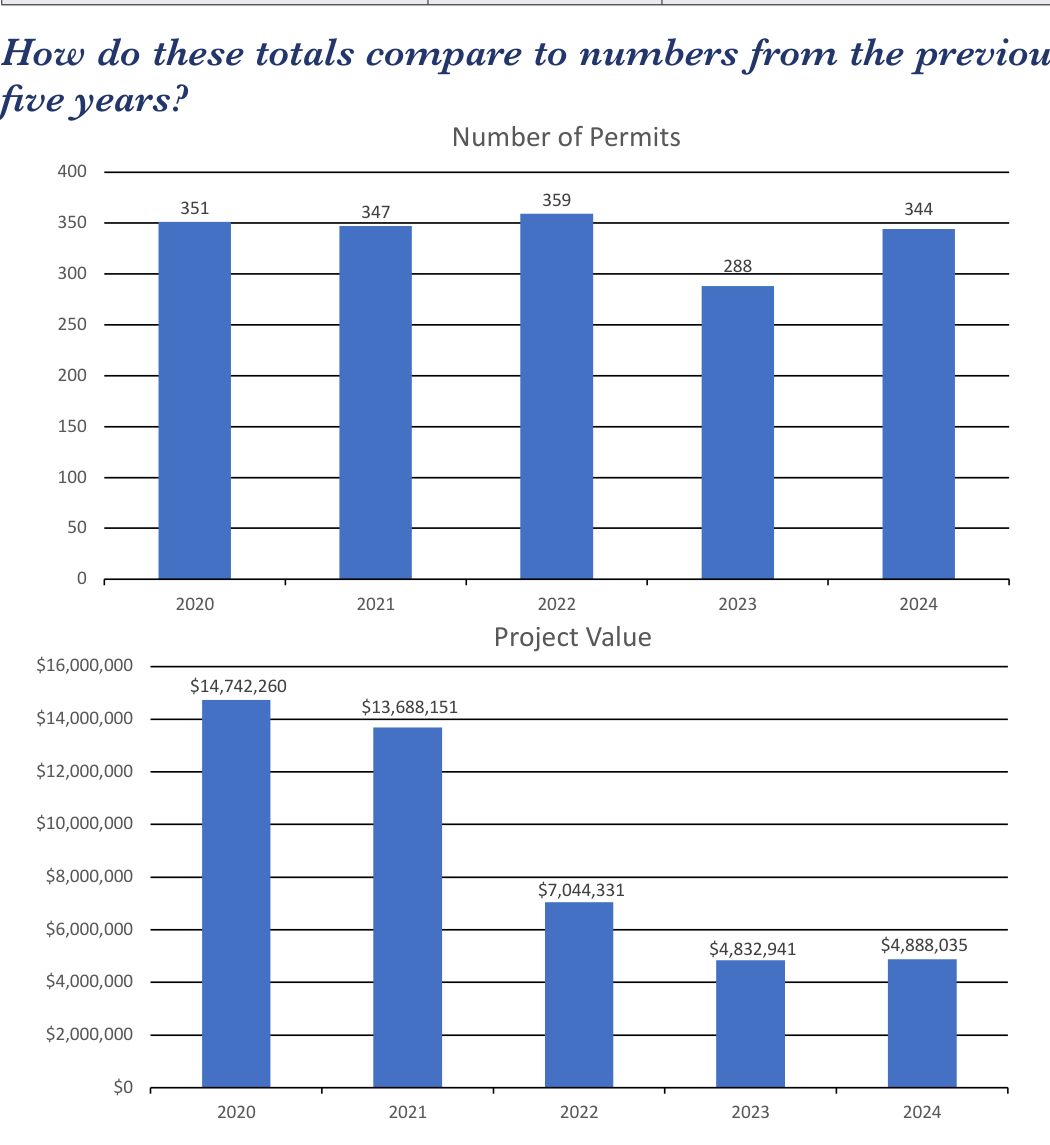
Five-Year Trends Summary (2020–2024)
Swipe or scroll horizontally to view all columns.
| Year | Number of Permits | Project Value ($) |
|---|---|---|
| 2020 | 351 | $14,742,260 |
| 2021 | 347 | $13,688,151 |
| 2022 | 359 | $7,044,331 |
| 2023 | 288 | $4,832,941 |
| 2024 | 344 | $4,888,035 |