which are almost non-reactive, the atoms of all other elements have incomplete valence electron shells. They therefore have a strong tendency to react with other atoms in order to achieve the stable arrangement of electrons emulating that of the noble gas in the same row. They fill their electron shells either by sharing electrons with other atoms, receiving electrons from other atoms, or transferring electrons to another atom. This model represents two types of chemical bonds between atoms:
- a covalent bond or molecular bond is a chemical link that involves the sharing of electron pairs between atoms. The atoms may share the electrons in equal proportion (non-polar covalent bond). It is also possible that one of the two partner atoms attracts the shared electrons more strongly (polar covalent bond);
- an ionic bond is formed when an atom donates one or more electrons to another atom that is able to accept electrons and ions are formed. It involves the electrostatic attraction between oppositely charged ions.
Non-metallic elements form molecules by establishing covalent bonds (Table 1.3). Examples are the reactive gaseous elements hydrogen (H), oxygen (O) and nitrogen (N), which exist as diatomic molecules (H2, O2 and N2). When atoms of different non-metallic elements are covalently bonded, they establish polyatomic molecules.
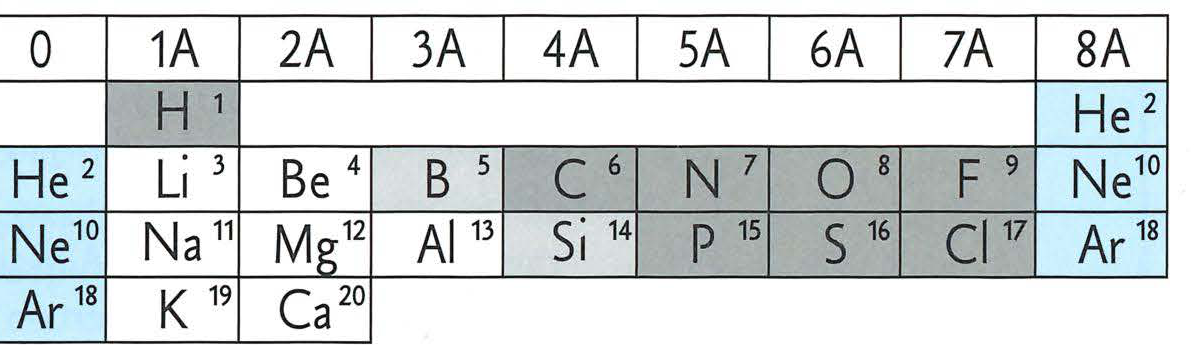
Carbon (C) and hydrogen (H), for example, form methane (CH4); hydrogen (H) and oxygen (O) form water (H2O). Both atoms donate at least one electron to a molecular orbital, which is formed by partial overlap of the outer electron shells of either atom. A simple example of the formation of a covalent bond is hydrogen, which forms stable (H2) molecules where two electrons are shared (Fig. 1.8). The formation of the hydrogen molecule follows the so-called duet rule. Initially, the two single hydrogen atoms have one electron in their electron shell, which is only half filled with respect to the noble gas, helium, that is positioned next to it in the periodic table. When these atoms approach, their atomic orbitals overlap so that they can share the two electrons equally. A molecular orbital for the two nuclei is created. Either of the