stable and non-reactive. However, bonds between carbon and elements with higher electronegativity that occupy the right side of the periodic table are polar because these elements, for example oxygen and nitrogen, strongly attract the valence electrons of carbon. The special ability of carbon to form polar and non-polar structures is important in our understanding of the cellulose molecule and therefore will be discussed in greater detail.
Organic chemistry is dominated by the so-called "functional group approach", whereby organic molecules are thought to be constructed from an inert (non-polar) hydrocarbon skeleton onto which functional groups are attached. A functional group is an atom or a group of atoms that exhibits similar chemical and physical properties whenever it occurs in different compounds (Table 1.6). A key role in the context of paper-water interactions must be attributed to hydroxyl or alcohol groups (R-OH) which define the characteristic physical and chemical
| functional group | name | compounds | possible reactions |
|---|---|---|---|
| R*-OH | hydroxyl | alcohols sugars cellulose starch phenol lignin polyethylene glycol (PEG) |
oxidation to aldehydes, ketones (1. step) carboxylic groups (acid) (2. step) |
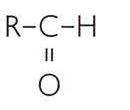 |
aldehyde | formaldehyde glucose reducing end group of cellulose chains in open form |
oxidation to carboxyl groups (acid) may be reduced to hydroxyl-, alcohol groups |
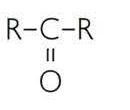 |
carbonyl | acetone | oxidation to carboxylic groups (acid) by oxidation agents may be reduced to hydroxyl-, alcohol groups by reducing agents |
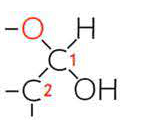 |
hemi-acetal | cyclic forms of glucose reducing end group of cellulose (99.74%) in equilibrium with the open aldehyde form (0.26%) |
in the open form acts as reducing agent is oxidsised by Fehling's reagent |
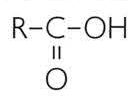 |
carboxyl | acetic acid amino acids 'internal acidity' of cellulose if attached to cellulose chain |
acid, donates (H+) in aqueous environment formation of insoluble salts with alkaline earth ions, such as Ca2+ or Mg2+ |
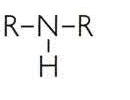 |
amine | amines | basic, accepts protons in an aqueous environment forms ammonium salts with acids |
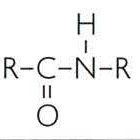 |
amide | proteins | crosslinks with aldehydes (i.e. tanning) |
* R stands for any "organic residue", e.g. CH3-, CH3-CH2- etc. attached to a functional group.
Table 1.6 Some important functional groups and their potential reactivities.