properties of any paper's core component: cellulose. These polar groups are bound to a hydrocarbon skeleton. Their polarity is not diminished by the fact that they are attached to a non-polar structure.
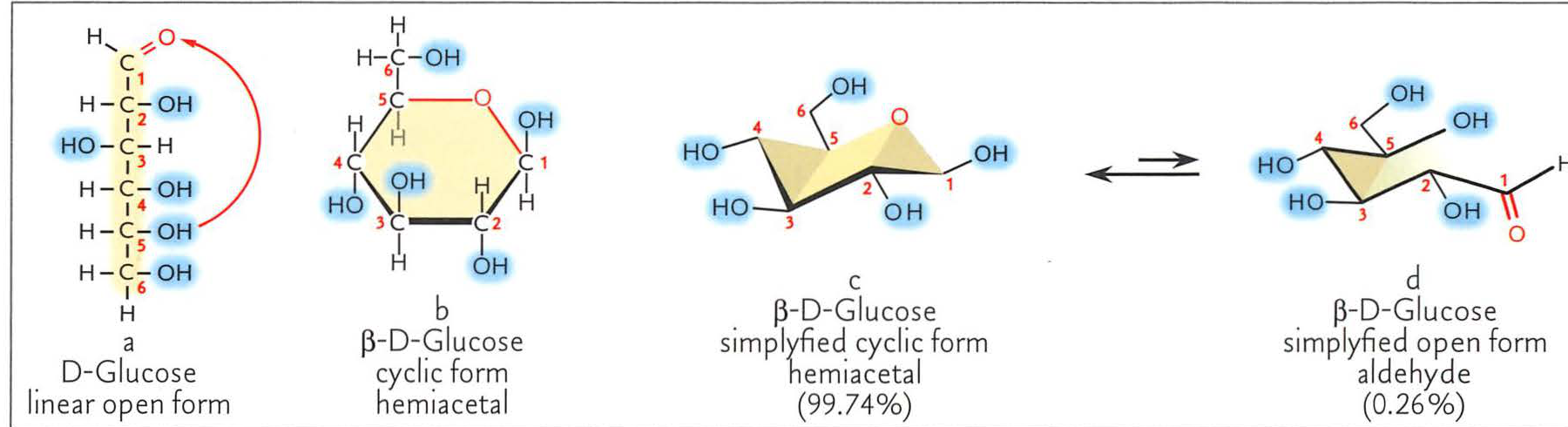
The affinity of cellulose to water is determined by the molecular structure of its monomer β-D-glucose. Glucose is a polyhydroxy aldehyde. The -ose ending indicates that it belongs to the group of carbohydrates. Glucose is a monosaccharide (Lat. saccharum = sugar) – a single sugar – having a hydrocarbon backbone consisting of six sp3 hybridised carbon atoms (see p. 17) labelled 1–6. It exists in a variety of isomers, and the two most basic are L-glucose and D-glucose. Both are of identical chemical composition, but their component particles are arranged as mirror images of one another. In Fig. 1.15 only D-glucose is shown. The molecule, when drawn according to the simplest convention, features the C–C skeleton in an open-chain form (Fig. 1.15a), where the 1-carbon is an aldehyde group (–CHO). All other carbon atoms (2–6) have one hydroxyl group (–OH) attached and the remaining bonds of the C–C skeleton are satisfied by hydrogens (–H). The molecule thus contains five polar hydroxyl groups.
Glucose is highly soluble in water (470 g/L H2O at 20°C). If dried, it solidifies to relatively hard and brittle crystals. Both properties must be attributed to the presence of hydroxyl groups, which function in that they establish a network of hydrogen bonds with hydrating water molecules keeping the glucose separated in solution. During solidification they interact via hydrogen bonds with each other and from a crystalline pattern.
In aqueous solution glucose exists in a dynamic chemical equilibrium (see p. 59) in its open-chain form and two cyclic isomers, i.e. α and β-glucose. In the following we will mainly concentrate on β-glucose that is the monomer of cellulose and is depicted in Fig. 1.15. The cyclic forms of glucose result from an intramolecular reaction between the aldehyde (C-1) and the hydroxyl (alcohol) group attached to the carbon atom 5. A hemiacetal is generated (see Table 1.6, p. 18) through formation of an oxygen bridge between the carbon atoms 1 and 5.