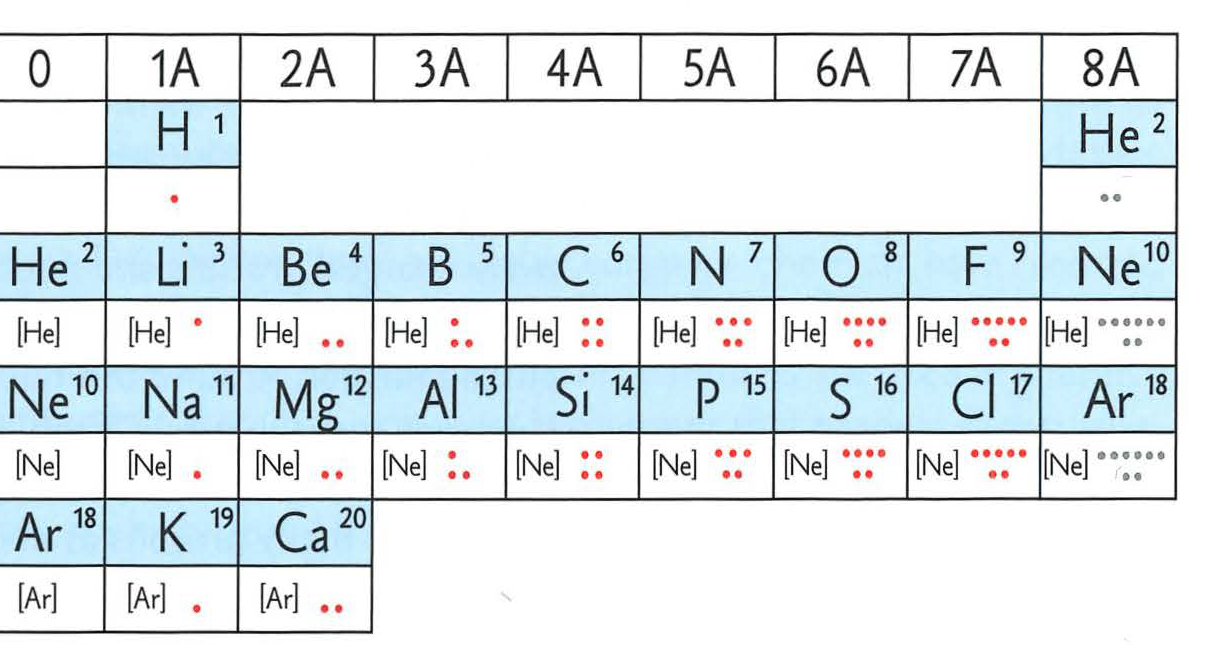
theoretical background of electron arrangement and their movement in atoms is much more complicated. Only a few facts necessary for further understanding will be discussed. First, the movement of electrons around the nucleus is not as simple as the circling of planets around the sun. Rather, they are present in defined regions that are called atomic orbitals. These regions of electron movement represent, according to a model created by the Danish scientist Niels Bohr (1885–1962), energy levels for the electrons of a certain atom. In principle, an atom is most stable when the electrons remain in their lowest energy level. When they are transferred to a higher energy state by the input of external energy, the stability of the atom is decreased and a chemical reaction may occur. The electron orbital of hydrogen and helium has a maximum capacity of two electrons. It is named 1s. The number indicates the ‘energy level’; in this case it is the nearest possible to the nucleus (1), and the letter indicates the orbital’s shape. The s orbitals have the shape of a spherical shell.
The second row of the periodic table looks more complicated because the elements listed there have up to 10 protons and 10 electrons. The arrangement of the electrons must follow a strict hierarchical order. They are arranged in two energy levels. One, the so-called core shell, is identical with the electron arrangement of the preceding noble gas helium (He). The second and outermost shell lies at a greater distance from the nucleus. It is the so-called valence shell, which has an allowance from one to eight electrons. Only the electrons in the valence shell are involved in any kind of chemical reaction.
A further differentiation lies in the fact that the valence shell in the second row consists of two sub-levels. These sub-levels are named 2s and 2p. The 2s orbital can take two electrons, the other maximum six electrons are placed in the 2p orbital. The existence of the two sub-shells s and p means that the electrons that are involved in chemical