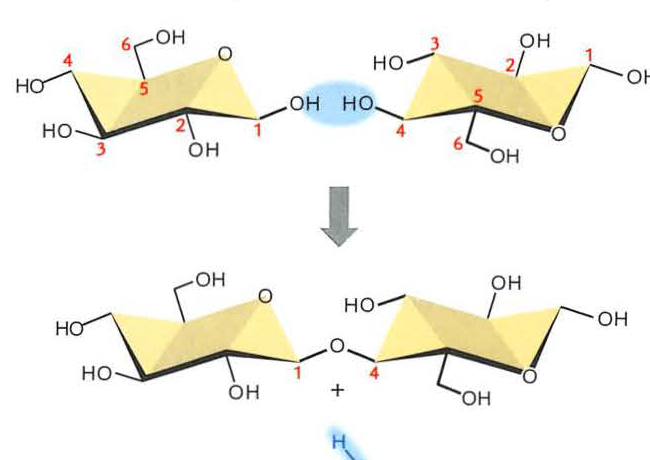
neighbouring molecule, termed β-1,4-glucosidic bond. Bond formation occurs under elimination of one water molecule as shown in Fig. 1.17 and glucose units joined together are named anhydroglucose because they have lost water (Gr. anhydros = waterless).
Fig. 1.17 Formation of the β-1,4-glucosidic bond. Two β-glucose molecules form a bond by the release of one water molecule.
Either of the two cyclic isomers, α-glucose and β-glucose, can be linked together to form polymers. The properties of these polymers, however, are substantially different even though their elemental composition is the same, (C6H10O5)n. The reason for this is the minor difference in their molecular geometry: α-glucose is the monomer of starch and β-glucose forms cellulose.
Two units of β-glucose linked by a β-1,4 glucosidic bond form the basic building block of cellulose called cellobiose (Fig. 1.17). Cellobiose determines the linear structure of cellulose chains. Considering that the formation of the glucosidic bond releases water, it is evident that breaking it always requires the consumption of water. This reaction is called hydrolysis (Gr. hydor = water, lysis = loosening) (see also section 8.2.1, p. 224–228). The building blocks of the cellulose polymer consist of a hydrocarbon skeleton that is essentially non-polar. Hence, the polarity of cellulose solely results from three hydroxyl groups pointing out from its anhydroglucose units (see 4.1, p. 83–87). This molecular structure makes cellulose “water-loving”, i.e. hygroscopic due to the interaction of its hydroxyl groups with water molecules. However, in contrast to glucose it is hindered from being dissolved in water by strong intramolecular forces resulting from competing hydrogen bond formation between cellulose chains, which cause the formation of dense localised ordered structures that are impenetrable to water.
Summary
The principles according to which atoms undergo chemical bonding are important for understanding their chemical and physical behaviour. A chemical bond can be regarded as the force that holds together a group of atoms in such a way that they form a molecule that acts as a collective unit. Two types of chemical bonds were dis–