1.2 Covalent
and ionic bonding
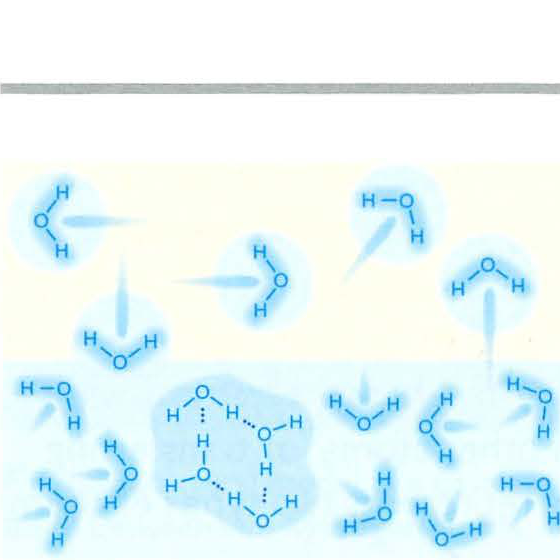
equilibrium. At equilibrium, neither the reactants nor the formed products are favoured energetically over each other and the reaction is complete. A chemical system at equilibrium presents the observer with an unchanging macroscopic appearance (Munowitz 2000). At the microscopic level, however, the equilibrium remains dynamic even though it represents a balance of competing processes, such as evaporation and condensation of water at a given temperature and atmospheric pressure (Fig. 1.5). The equilibrium remains stable unless it is driven out of balance by changing the environmental conditions, such as temperature, atmospheric pressure or the partial pressure of one component in the atmosphere, such as water vapour. Conservators apply and remove water from paper in all three aggregation states, as liquid, as gas and, rarely, as solid. To move water in or out of the paper always requires that the equilibrium between concentration of water vapour in the atmosphere and the water molecules fixed to the papermaking fibre by physical attraction forces is disturbed (see Chapter 10, sections 10.1 and 10.2, p. 305-312).
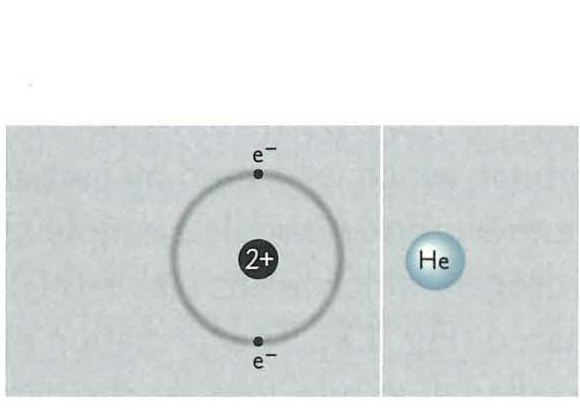
Generally, a chemical bond is a link between atoms. It creates a molecule that, by definition, is an arrangement of two or more atoms linked together. A bond is formed by rearrangement of the negatively charged electrons belonging to either of the atoms involved in its formation. Electrons are in constant motion around the positively charged nucleus of an atom and occupy certain energetic regions. Much information concerning the principles by which elements undergo chemical reactions and form molecules can be drawn from the periodic table. In this chart, all known elements are grouped in vertical columns, also referred to as ‘groups’, according to similarities in their chemical behaviour. Although each element has a unique configuration, it also shares certain properties of other elements that belong to the same group. This is due to the fact that the elements in one column have the same number of electrons in the outermost shell, the so-called valence shell. These electrons – and only the electrons – are involved in chemical bonding. They are thus called valence electrons (Table 1.1). The number and type of valence electrons are of overall importance for chemical bond formation, and thus determine an atom’s chemistry. An atom is stable and chemically non-reactive when its outermost electron shell is completely filled with the maximum possible number of electrons. This is true for noble gases, the elements in group 8A of the periodic table, such as helium (He), with two electrons that fill its shell (Fig. 1.6) The next noble gas in the periodic table is neon (Ne), with eight electrons in its outermost shell (Fig. 1.7). With the exception of the noble gases,