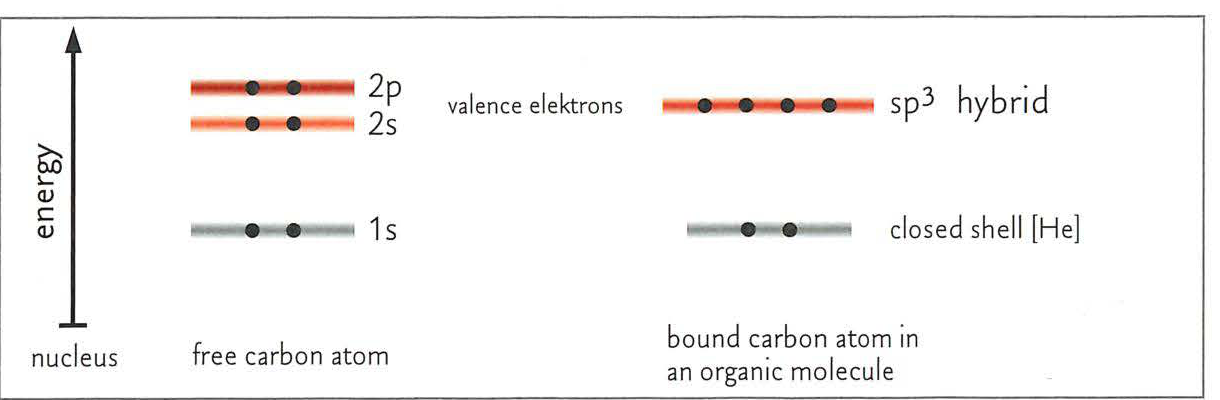
accepting four electrons within its valence shell (Table 1.1, p. 4). The four electrons in the outermost shell of the carbon atom, the valence electrons, are involved in chemical bonding (Fig. 1.12).
However, the four valence electrons move along two orbitals, the 2s and 2p orbitals, that represent different energy levels. To explain the way bonds determine the geometry of polyatomic organic molecules, one uses the model of hybrid orbitals. In the case of carbon, a hybrid atomic orbital is obtained by mixing non-equivalent orbitals 2s and 2p in preparation for covalent bond formation. Four hybrid orbitals are generated through the hybridisation of one s and three p orbitals, which are termed sp3 hybrids (Fig. 1.13). The hybrid orbitals, in contrast to the s and p orbitals from which they are generated, have the same energy. The equivalent hybrid orbitals must occupy positions at maximum distance from each other, which causes them to be oriented so that they point towards the four corners of a regular tetrahedron. In its centre lies the atomic nucleus. The angle formed by the hybrid orbitals in the tetrahedron measures 109.5°.
The hybridisation occurs in all situations where carbon is bonded with other atoms, e.g. in the compound CH4 (methane), where four hydrogen atoms are covalently bonded to carbon (Fig. 1.14). Hybridisation means that when carbon is bonded to another atom, it always has a symmetrical bonding situation. This bonding situation is energetically favourable. It also means that carbon bonds are always arranged at 109.5°. If only two or one, not all three, p orbitals are involved in hybridisation with the s orbital, sp2 and sp hybrid orbitals result. These orbitals have different geometries.
Carbon has an electronegativity that is similar to hydrogen (Table 1.4, p. 13). In a molecule that contains only carbon and hydrogen there is therefore negligible polarity. The C–H bond is exceptionally