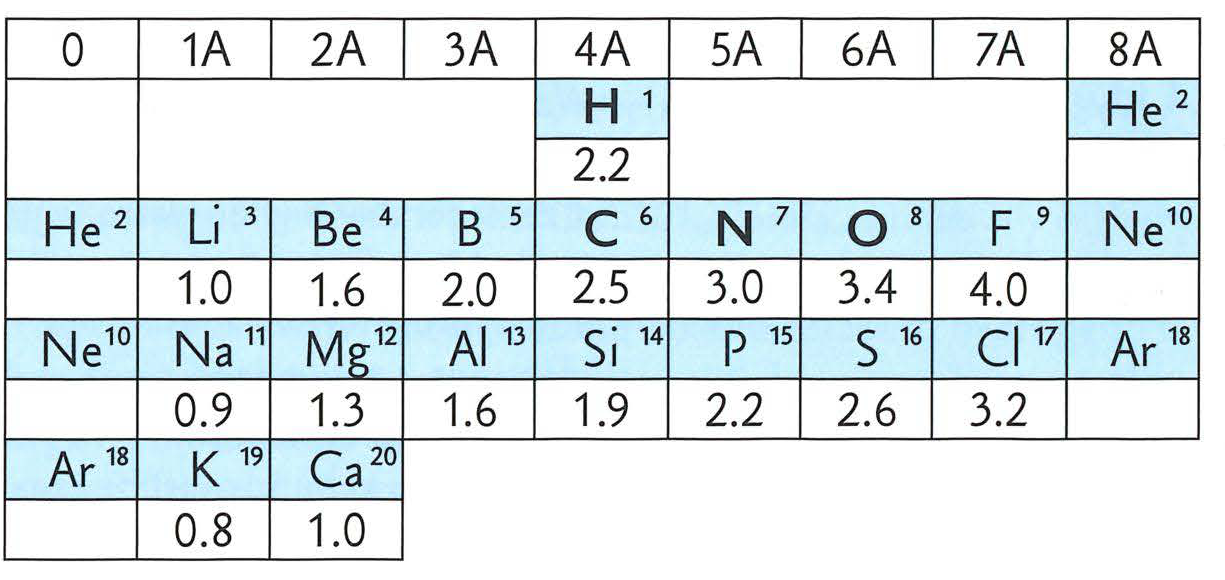
the shared binding electrons forming the covalent bond. It is expressed as a relative value that can best be used for comparing elements. The non-metals fluorine (F), oxygen (O), chlorine (Cl) and nitrogen (N) on the right side of the periodic table are the elements with the highest electronegativities. By contrast, the metallic elements on the left side of the periodic table, such as lithium (Li), sodium (Na), potassium (K), magnesium (Mg) and calcium (Ca), are species that easily give away electrons. They may be regarded as ‘electropositive’ elements or, more correctly, as elements with little electronegativity. In the middle of the periodic table are found the elements with electronegativity values ranging from 1.9 to 2.5. These elements, for example carbon (C) and hydrogen (H), share binding electrons almost equally. The electronegative value of hydrogen (2.2) is similar to that of carbon (2.5) (Table 1.4). To make this feature clear, the representation of the periodic table in Table 1.4 is modified in that hydrogen is placed above carbon in the middle of the first row, while it is usually placed above lithium (Li) on the far left.
When elements of high electronegativity, such as oxygen or nitrogen, are bound to an element with significantly lower electronegativity, for example hydrogen, we can expect them to exert a strong attraction on the binding electrons they share. This results in an unequal charge distribution across the molecule. The molecule thus exhibits a partial negative charge at the position of the electronegative element and a partial positive charge at the position of its less electronegative partner atom, although the molecule as a whole remains electrically neutral. This uneven distribution of electrons across a molecule or a molecular group is normally indicated in textbooks by the prefixes δ⁺ and δ⁻. A group formed from oxygen and hydrogen, for example, will be noted as (δ⁻O–Hδ⁺). Such a molecular group has two poles in an electrical sense and is called dipolar. The term polar is used synonymously with dipolar. Polar molecules attract each