discussed in this book. Cellulose attracts water strongly. This property, called hygroscopicity, is due to the formation of hydrogen bonds between its hydroxyl groups (–OH) and water molecules. Hydrogen bonds are also responsible for the cohesion between individual cellulose molecules. This type of intermolecular attraction is capable of forcing cellulose molecules to form fibrous structures.
1.5 Van der Waals forces
Even non-polar molecules experience forces that act between them. These rather weak intermolecular forces are named after the Dutch physicist Johannes Diderik van der Waals (1837–1923) van der Waals forces. They arise because the electron clouds of molecules are not static. As the electrons move around the molecule, a momentary non-symmetrical electron distribution can develop, resulting in a temporary dipolar charge. This temporary dipole can affect the electron distribution in a neighbouring molecule. That is, the temporary dipole can induce a similar dipole in an adjacent molecule. Instantaneously, partial charges on the molecules are formed that cause them to be attracted to each other. As electrons are in continuous motion in all atoms and all molecular structures, it is clear that this type of intermolecular attraction is operating between all atoms and all molecules at all times. Van der Waals forces increase in strength with the number of electrons present in the molecules – in other words, with an increase in the molecular mass or the degree of polymerisation (DP). Van der Waals forces therefore are significant, especially for large non-polar molecules.
Selected characteristic data, namely bond lengths and dissociation energies, for some chemical bonds and physical interaction forces are compiled in Table 1.2 (p. 8). In principle, the stability of a molecule depends on the energy needed to break an individual bond. Like a metal chain with weakened chain links, a molecule breaks at the location of the weakest bond. The energy needed to break a bond, the dissociation energy, can be used to predict stability properties of the molecule.
1.6 Carbon and glucose
The carbon atom has the ability to bond with any other carbon atom, forming C-C<" class="formula-img"> bonds, which allows them to link with each other in chains and ring structures. This is the basis of all organic chemistry. Organic compounds consist primarily of carbon and hydrogen atoms, and additionally contain mainly nitrogen, oxygen and sulphur. The special property of the carbon atom to bond covalently with other carbon atoms can be explained by its central position in the second row of the periodic table. Carbon may achieve a stable electron configuration like the neighbouring noble gases helium (He) to its left (group 0) or neon (Ne) to its right (group 8A) by either donating or
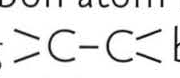 C-C<" class="formula-img"> bonds, which allows them to link with each other in chains and ring structures. This is the basis of all organic chemistry. Organic compounds consist primarily of carbon and hydrogen atoms, and additionally contain mainly nitrogen, oxygen and sulphur. The special property of the carbon atom to bond covalently with other carbon atoms can be explained by its central position in the second row of the periodic table. Carbon may achieve a stable electron configuration like the neighbouring noble gases helium (He) to its left (group 0) or neon (Ne) to its right (group 8A) by either donating or