4.4 The structure of dry and wet paper
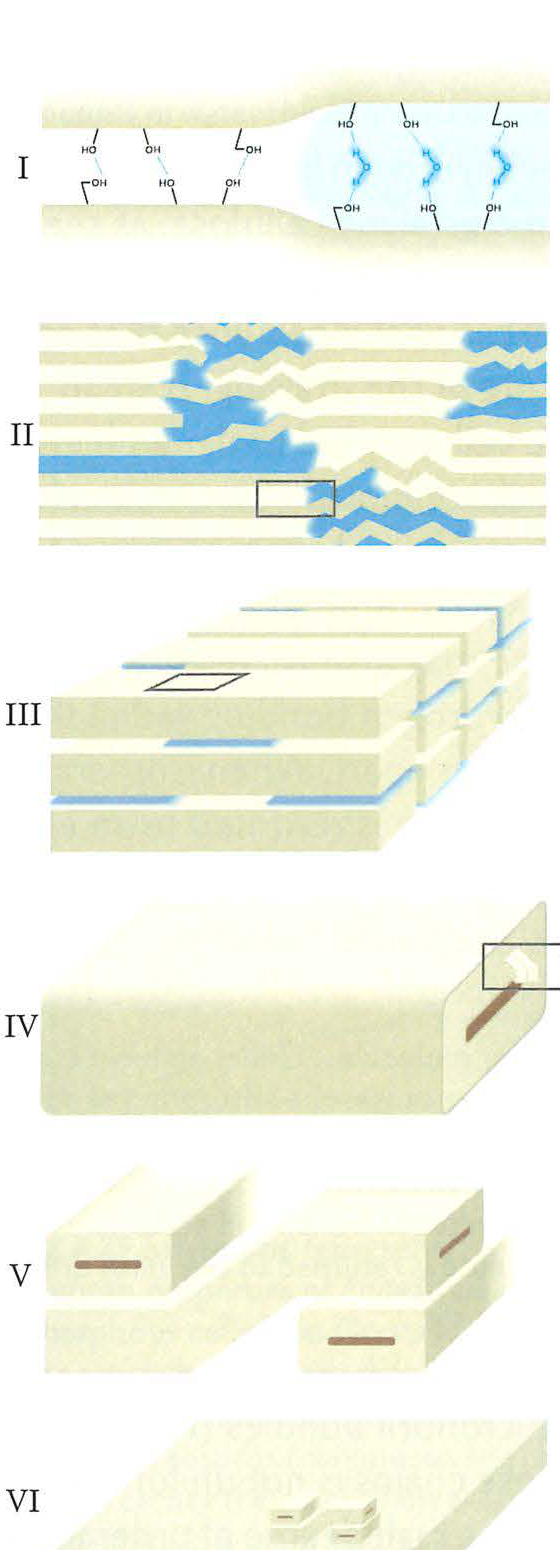
Fig. 4.16 Model of the structural levels of paper. Two adjacent cellulose molecules (I) lie parallel to each other within the microfibril (II). Bundles of them form a lamella (III). Lamellae make up the thickness of the cell wall of the papermaking fibre (IV). Fibres are bonded to each other, forming the paper microstructure (V). Many fibres make up the macrostructure of the paper sheet (VI). Small amounts of water are always present in paper under ambient conditions, as indicated in levels I–III that are subsumed in levels IV–VI.
The paper structure can be visualised in a model featuring six levels (Fig. 4.16). Starting at the molecular level, each cellulose entity can be incorporated into a progressively larger building block. Taken together, the building blocks establish the paper sheet. Such a model allows the separate study of each level within the context of the whole. The first level concerns the cellulose molecule. The second level concerns the microfibril, which is a slender bundle of cellulose molecules and constitutes the smallest building block in the fibre cell wall. On the third level, microfibrils aggregate to form larger fibril bundles that constitute the morphological structure of the fibre cell wall. The fourth level features the single fibre, and the fifth level shows the bonding between single fibres that establishes the coherent sheet structure. The sixth level concerns the paper sheet as a whole and shows the overall effect of the multitude of fibres on sheet properties. Seven orders of magnitude in scale lie between these levels (Table 4.1). Depending on the fibre type, the configuration of the
|
structural unit |
number of entities |
dimensions |
| width |
length |
| I |
cellulose molecule |
1 cellulose molecule |
0.33 nm |
~1000 nm |
| II |
microfibril |
~2000 cellulose molecules |
2–50 nm* |
2–<10 µm* |
| III |
lamella |
~millions of cellulose molecules |
~40 nm |
>1 µm |
| IV |
fibre |
~billion cellulose molecules |
1–100 µm* |
1–10 mm |
| V |
paper microstructure |
several fibres |
~100 µm |
~100 µm |
| VI |
paper macrostructure |
millions of fibres |
>10 mm |
>10 mm |
Table 4.1 The structural levels of paper.
* Lavoine et al. (2012)
|
structural unit |
action of water |
| I |
cellulose molecules |
establishes hydrogen bonds to cellulose |
| II |
microfibril |
absorbs into amorphous cellulose regions |
| III |
lamella |
swells the cell wall |
| IV |
fibre |
swells the fibre Ø, increases its flexibility |
| V |
paper microstructure |
weakens interfibre bonding, allows fibres to shift |
| VI |
paper macrostructure |
swells paper, weakens tensile strength, increases ability to elongate (tensile stretch) |
Table 4.2 Principal effects of water at different structural levels of paper.