Shape
Awnings may be standard stationary, canopy, retractable, concave, or dome.
Residential
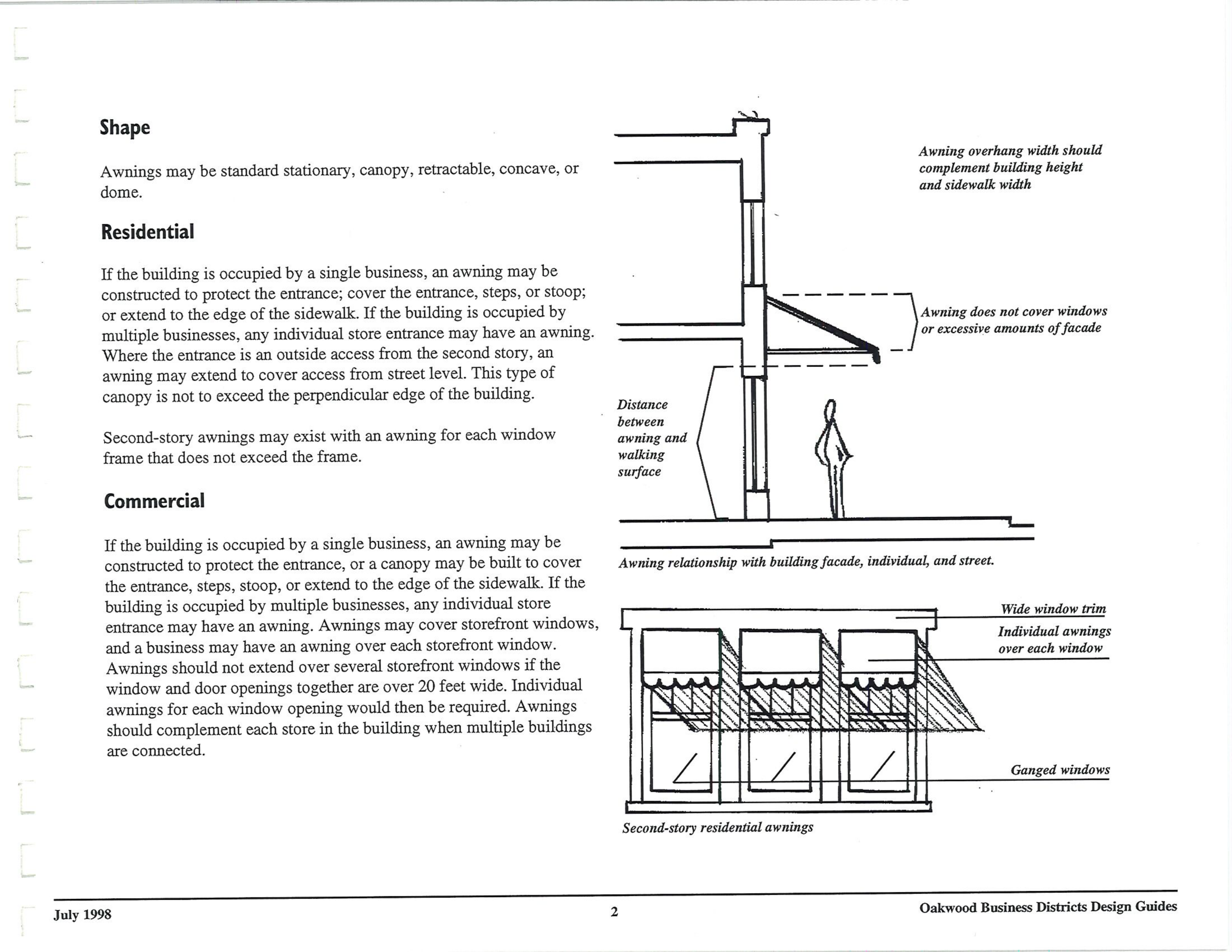
If the building is occupied by a single business, an awning may be constructed to protect the entrance; cover the entrance, steps, or stoop; or extend to the edge of the sidewalk. If the building is occupied by multiple businesses, any individual store entrance may have an awning. Where the entrance is an outside access from the second story, an awning may extend to cover access from street level. This type of canopy is not to exceed the perpendicular edge of the building.
Second-story awnings may exist with an awning for each window frame that does not exceed the frame.
Commercial
If the building is occupied by a single business, an awning may be constructed to protect the entrance, or a canopy may be built to cover the entrance, steps, stoop, or extend to the edge of the sidewalk. If the building is occupied by multiple businesses, any individual store entrance may have an awning. Awnings may cover storefront windows, and a business may have an awning over each storefront window. Awnings should not extend over several storefront windows if the window and door openings together are over 20 feet wide. Individual awnings for each window opening would then be required. Awnings should complement each store in the building when multiple buildings are connected.