Pedestrian Hybrid Beacon (PHB)
EDC-4 STEP: https://www.fhwa.dot.gov/innovation/everydaycounts/edc_4/step.cfm
Figure 4F-3. Sequence for a Pedestrian Hybrid Beacon from FHWA's Manual on Uniform Traffic Control Devices, 2009 Edition, p. 511
1. Dark Unit Activated
2. Flashing Yellow Upon Activation
3. Steady Yellow
4. Steady Red During Pedestrian Walk Interval
5. Alternating Flashing Red During Pedestrian Clearance Interval
6. Dark Again Until Activated
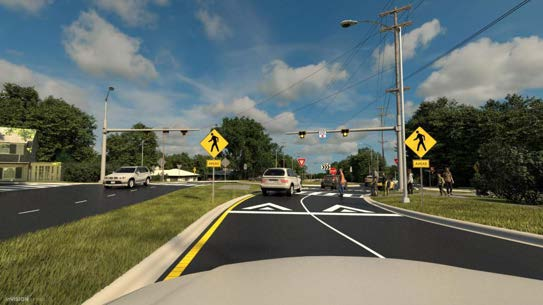
When a pedestrian activates a PHB, a flashing yellow light is followed by a solid yellow light, alerting drivers to slow. A solid red light requires drivers to stop while pedestrians have the right-of-way to cross the street. When the pedestrian signals display a flashing DON'T WALK indication, the overhead beacon flashes red, and drivers may proceed if the crosswalk is clear.
References
Zegeer, C., R. Srinivasan, B. Lan, D. Carter, S. Smith, C. Sundstrom, N.J. Thirsk, J. Zegeer, C. Lyon, E. Ferguson, and R. Van Houten. (2017). NCHRP Report 841: Development of Crash Modification Factors for Uncontrolled Pedestrian Crossing Treatments. Transportation Research Board, Washington, D.C.
Federal Highway Administration. (2013). “Pedestrian Hybrid Beacon” in PEDSAFE: Pedestrian Safety Guide and Countermeasure Selection System. Available: http://www.pedbikesafe.org/PEDSAFE/countermeasures_detail.cfm?CM_NUM=53
Bushell, M., Poole, B., Zegeer, C., & Rodriguez, D. (2013). Costs for Pedestrian and Bicyclist Infrastructure Improvements: A Resource for Researchers, Engineers, Planners, and the General Public. Pedestrian and Bicycle Information Center.