The Federal Highway Administration (FHWA) has determined through various studies that the acceptable range of daily traffic for a road diet as discussed in this report is 15,000 to 24,000 vehicles per day. The average daily traffic volume on Shroyer Road of 15,000 vehicles per day is well below the 24,000 upper threshold.
Research has documented a 19 to 47 percent reduction in overall crashes when a road diet is installed on a previously four-lane undivided facility. ODOT recognizes that an average crash reduction of 30 percent can be expected for all types and severity when converting a 4-lane section to a 3-lane section of a minor arterial roadway such as Shroyer Road. A reduction in crashes involving drivers under 35 years of age and over 65 years of age has also been documented with a road diet. Crashes involving at least one driver under 35 years old or greater than 65 years old comprised 73 percent of all crashes on Shroyer Road.
The revised cross section on Shroyer Road consists of through lane widths of 11 feet (plus a 0.5 ft shoulder adjacent to the raised median), dedicated bike lanes of 5 feet, and an 11 ft raised median. Figure 4 is a typical section of Shroyer Road showing pavement dimensions adjacent to the raised medians. Note that the existing concrete curbs remain in the same location as they exist today.
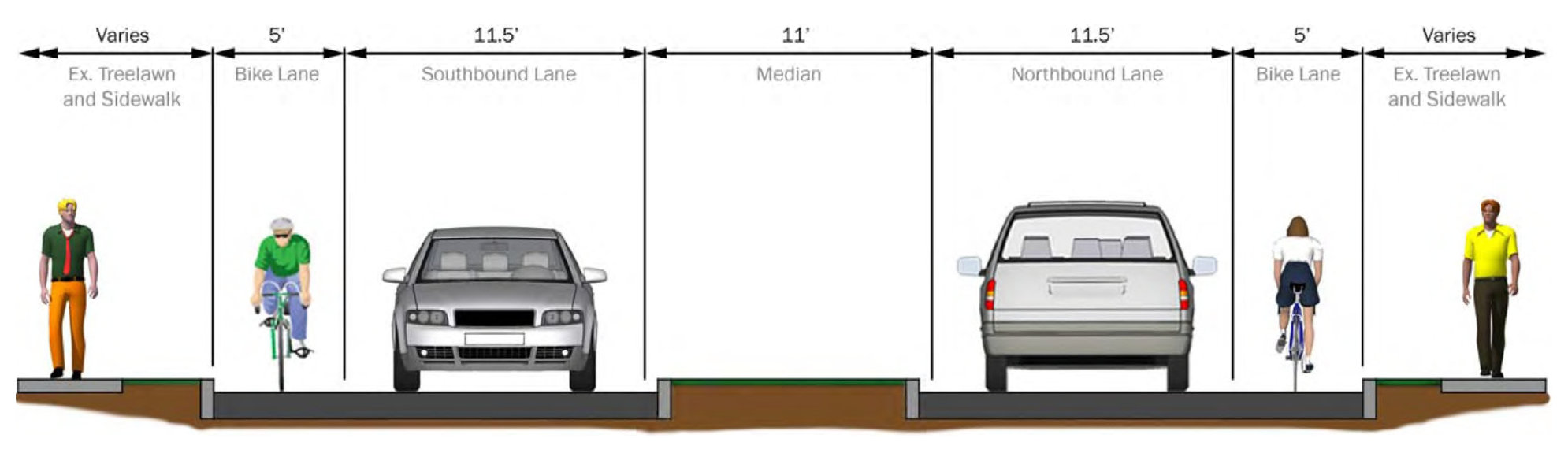
Figure 5 are conceptual plans of the Shroyer Road corridor as a 3-lane section. Additional information about the various design features of the road diet are included in the following section.
Operational factors taken into consideration as part of the proposed cross section includes the following:
- Median Type. A raised median (11 feet wide) is proposed between unsignalized intersections to maximize the safety benefits of the proposed improvement. The crash rate of 3.1 million vehicle miles traveled (MVMT) for the Shroyer Road corridor having an access density of approximately 60 per mile is lower than what can be expected for an undivided roadway. The installation of a raised median is shown to reduce the crash rate from existing levels based on the trends shown in Table 5 (The Handbook of Highway Engineering, 2004).